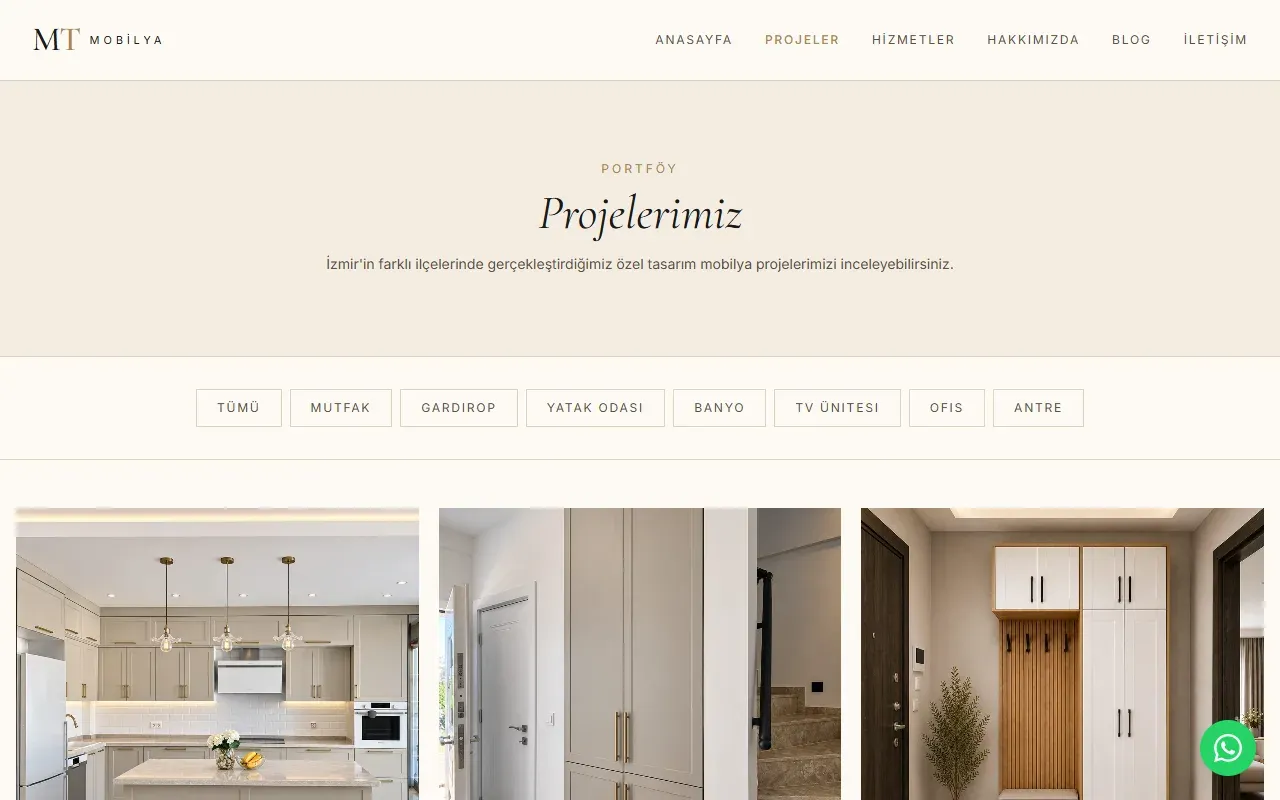
MT Mobilya is a workshop in Izmir that makes custom furniture: kitchen cabinets, wardrobes, TV units, and more. It had no website before. The site, built in May 2026, now has 21 pages and grows as new work comes in. This post covers how the site was built and why it was built this way.
The first question: who will update the site?
This came before any technology choice, because the answer shapes everything else. MT Mobilya would not touch the site itself. When a job was finished, it would send over the photos and details, and Yusuf would add them.
In that setup there is no need for an admin panel, user logins, or a content management system. No panel also means no plugins to update and no login page to protect.
Why Astro
The site is content-heavy: services, projects, posts. Nothing on screen changes per visitor. For a site like that, there is no need to build pages on a server for every request; building them once, in advance, is enough. Astro does exactly that, producing plain pages with nothing running on a server. The pages are published through Cloudflare Pages. Styling uses Tailwind CSS.
One file per project
The heart of the site is its content files. Each project is a separate text file, and every file starts with the same fields: title, short description, location, district, category, style, material, date, main photo, and a list of photos. The file for "Menemen'de Vizon Renkli Ada Mutfak" (a mink-colored island kitchen in Menemen), for example, lists its location as "Menemen, İzmir" and its category as "kitchen".
Because the fields are fixed, the site won't build if something is missing, so an incomplete project page can't go live. Adding a new project takes no code: a ready-made template is copied, the fields are filled in, and the photos go into their folder.
A page for every service
Kitchen cabinets, wardrobes, TV units, bathroom cabinets, office furniture, and bedrooms each have their own page. Every address includes "izmir", and every service file carries its own search title, description, keywords, and frequently asked questions. Someone searching for a kitchen cabinet maker in Izmir can land straight on the kitchen page instead of a general services page.
Blog posts are stored the same way, with a title, description, date, category, and tags. The site currently has 3 posts.
The phone number lives in one place
The phone number, WhatsApp number, and email sit in a single configuration file. The number is stored in two forms: the way it appears on the page and the way it is used in the call link. When something changes, one line in that file changes, and the whole site updates with it.
For visitors, the shortest route is WhatsApp: every page has a fixed WhatsApp button, and the service pages include a direct message link.
Search basics
The sitemap is generated automatically. Every page has a title, a description, a canonical address, and social sharing tags.
How updates work
When a change is pushed to GitHub, Cloudflare rebuilds and republishes the site on its own. New projects were added this way in July and September 2026; the latest were two projects from Menemen.
The result
A 21-page site with 6 service pages, 6 project pages, and 3 blog posts. The deciding factor wasn't the technology but the answer to the first question: who updates the site. Once the answer was "the workshop sends a request and Yusuf makes the change," the simplest setup was also the right one.
Working on something similar? Get in touch on the contact page.